Showing posts with label inspiration. Show all posts

Monday, October 11, 2010

Lynn Krawczyk's Fabric Making Freedom Song


Detail of Virginia Spiegel's Then and Now art quilt using
thermofax technique
 
Virginia Spiegel first introduced me to the concept of thermofax printing. Other than the difficulty of finding a thermofax machine and its high cost, I fell immediately in love with the technique and freedom and versatility of printing one's own fabric.

Virginia has done a great deal of experimenting with fabric painting and thermofax among other techniques. Here are two examples of her work: "Then and Now" and "Once."

For more information about her two quilts, and her about to begin Birthday Bash where we can buy bundles of her fabric, go to her website. Her Birthday Bash info is available through her blog.

Once art quilt by Virginia Spiegel
Then I saw Claire Fenton's "Demystifying Thermofax Screen Printing" DVD from Quilting Arts Workshop and it came together. She built a piece using headlines from the Hurricane Katrina disaster. I fell in love with making fabric tell a story.

The DVD may not be glitzy but Claire gives the nuts and bolts of making one's own screens as well as does and don'ts and how to save a bit of money and not waste inks, etc. She gives a most informative demonstration. It really got exciting for me when she begins creating her own fabric. I'm a words person and adored the idea of thermofaxing favorite newspaper clippings and articles. my own clippings, onto a fabric that only I could make. My indulgence in thermofax techniques for fabric making continue to ferment.

After hearing Lynn Krawczyk's song of freedom that printing her own fabric gave her -- I'm heading for the garage to make a space for some fabric printing!

I think you'll find inspiration in Lynn's work as well as her words! Here is Lynn Krawczyk in her own words. -- Dawn

Lynn Krawczyk:
I've come to regard my studio as a sort of diary of the ten years I've spent creating fiber art. My decorating sense in that room is not of the variety of plain white walls and no distractions. I pile and layer -- not distractions but inspiration - everywhere, both mine and acquired. I want to be encased in all things creative. My mind slips into proper order the moment I walk through the door.

Photo of Lynn's design board and various creations in all stages of design.

Where I started and where I am now are related but in the way that you stand next to a cousin and think, "I could see where we are from the same family." The studio connection past and present is there along with evidence of the search to find that sweet comfort spot. It is a kind of tilling and combining of elements and finding the ah-ha beauty that draws an unconscious comfortable sigh from me, telling me that I am home.

 
Lynn's Big Orange Chair with White Background. What a
delight and so original!

It wasn't until I started creating my own fabric about a year ago that I knew I was almost there. I know I'm not the first to do it and I know I won't be the last but what it has given me has changed nearly everything that goes on in that little room at the end of the second floor hallway.

If I said that I didn't own or use any commercial fabric, that would make me a liar. I am, after all, a bona fide fabric addict. But I find myself reaching around the commercial bin in my studio when I'm creating wall art. (The funky batiks and prints make their way into other projects these days. The plushies I create are more then happy to sport colorful stripes and bizarre swirls on their tummies.)

I've tried long and hard to explain the things that I love most about hand printed fabric. I smooshed all the reasons into a Top Ten list that perfectly sums up my affection for the whole bit:

(1) Fast food vs. homemade. I admit that I do love me some fast food but I also admit that it can't really begin to compare to homemade food. I think a big part of it is the difference between who is making it: a hormonal disgruntled teenager vs. your mom. Mom adds love - an ingredient that shows through in the final product. Its the same with printing your own fabric - your emotion becomes embedded in the fibers.

Photo of thermofax screen printing process

(2) Freedom. Freeeeeddddoooommm! Freeeeddddooooommmmm!!! Instead of searching
high and low to find the fabric that I want to use to convey a message, all I need to do is hunker down in my studio for a couple of hours and I've got exactly what I need.

(3) Magic. No matter how many times I use thermofax screens to screen print or slop soy wax on to create batik fabrics, it never gets old. I won't say this for sure but its possible that I shout "Ta-da!" each and every time.


Painting Soy Wax, just one of the options when making your own fabric
 (4) Connection. I love that I can spill my mood out onto something tangible. Its easy to convey whatever I'm thinking since I have control over the whole process from start to finish. Its a sort of fabric journal, a documentation of what I was thinking on that specific day.

(5) Be specific! I tend to print fabric as I need it for a project rather then creating it for my stash. (Although there is a little stash fabric in there as well.) I can bend the fabric to my will rather then the other way around. There is no compromise on the final product.


On the Line, a combination of planning and serendipity
 (6) Pass the soap please. I get to make a mess. A valid, necessary, unapologetic mess. Paint, wax, dye - you name it, I have a reason to involve it all in the mayhem. The day that I realized I required an apron to avoid making my entire wardrobe studio clothing is the day I realized I was right where I needed to be.

(7) Intentional serendipity. I enjoy surprising results when creating something but there comes a point and time where you want more control over how things are coming out. I can assemble my every growing stack of thermofax screens, my paints, my dyes and while I cannot see the results entirely in my mind when I begin, I can guide it along the path I want to get what I need.

(8) One of these things is not like the others. Its impossible to create the same piece of fabric twice. No matter how hard I try (and I normally don't), its wasted effort. Knowing that each one is different and unique
and an only child makes each one my favorite. And that's a happy place to be.
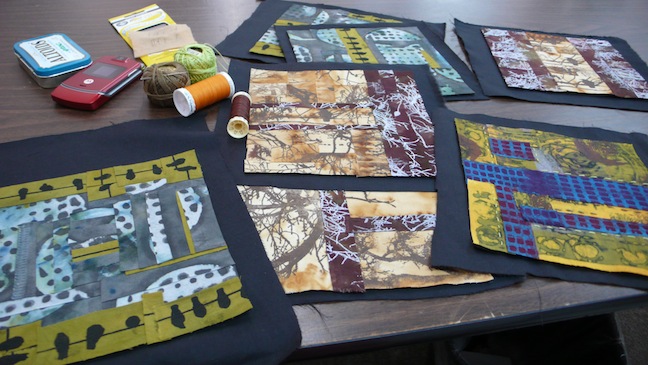

Lynn adds graphic hand stitching to her thermofaxed fabrics
 (9) The star of the show. I like to do graphic hand stitching, simple and to the point. Creating a piece of work in which the hand printed fabric is the star of the show, the stitching is there to compliment the design and add those little tweaks of happiness. The fabric is the star and everything else in the work moves around it to make sure that it stays that way.

Adding layers to create the design
(10) Joy. Printing my own fabric is a joyful process. It makes me happy. Plain and simple and to the point. And sometimes, that's more then enough reason to do something - to put a smile on your face.


Creating art is about finding your joy. There is no right or wrong way to find it, you just have to plod along until that "a-ha!" moment settles over you. It can be dramatic and come out in a shout or be quiet and as simple as drawing paint across a silk screen.

However you define it, move forward. Keep working. Don't question. And never doubt that you are an artist.

Happy creating!

For more of Lynn's beautiful work and inspiring words, please visit her website, her blog, and her Etsy shop.

Saturday, June 26, 2010

Everything old is new again in Mary Kerr's world


Vintage to some are those musty stained remnants of another era. A reminder of grandma's handiwork that is relegated to a cedar chest. We stand clueless as to how to rejuvenate them or integrate them into our current art, quilts or lives.

But for Mary Kerr vintage is the vision for something new and exciting. She challenged several friends and colleagues to use vintage and this lead photo shows Cyndi Souder's interpretation. Old certainly never looked so new! You will be surprised and amazed at what Mary can make out of something old....

Please welcome Mary Kerr in her own words. -- Dawn

I love all things old…. rustic furniture, old friends, driftwood at the beach and antique textiles.

Lots of antique textiles!

I have collected vintage quilts for years and have a large collection that travels with me to teach and lecture. In addition, I hoard fragments of quilts, orphan blocks, linens and sewing “stuff” ---- buttons, lace, sewing cards, etc. I have never been picky about condition and often find myself bringing home the runt of the litter --- that tattered piece that no one else can imagine as useful. My passion is to incorporate these cast-off pieces into contemporary quilts.

My work ranges from traditional to art.
I am not bound by a single genre as long I am able to incorporate my vintage pieces into each design. Stars for Grandma Kay (See Photo 2) was included in the IQA Quilts in the American Tradition exhibit that traveled in 2007-2008. The central appliqué unit was found in my Grandmother’s home and is circa 1940. I pieced the stars and saw tooth border using vintage fabrics and incorporated a fragment of a damaged Flower Garden top from the 1930’s. Only the black fabric was purchased new. It was hand quilted by Didi Salvatierra.

The art piece, I Would Dance (See Photo 3) was created for my local guild challenge. Each participant was given a fortune cookie and challenged to create a quilt inspired by the fortune. Mine asked, “What would you do if you had no fear?”

I created this piece using fragments of lace, linens, jewelry and buttons that had belonged to my grandmothers. The foundation is a scrap of a cutter quilt and the pieces are layered beside the image of me dancing.

This was my first vintage collage quilt and began a series of quilts that all incorporate those nontraditional pieces we find in our sewing baskets, jewelry boxes and dresser drawers. I love teaching this technique and watching as my students get excited about incorporating these treasured pieces into their quilts.

I will frequently work with orphan blocks and finish them in a variety of ways. This set of four small quilts was created during a beach retreat when I was playing with techniques and design. Each of the 11 inch quilts incorporated a vintage pink and white star block, circa 1940. Edisto (See Photo 4) features marbled fabric by Linda Cooper and found objects from my morning beach walk.


Happy Hour (Photo 6) plays with folded fabrics and button embellishment.
Tropical Smoothie (See Photo 5) showcases a woven technique with thread painting.


Pretty in Pink (Photo 7) is a cascade of buttons over a simple pieced background.


As I played with various sets of vintage blocks, I began to wonder what would happen if we divided a set of blocks among a larger group of artists?

Would anyone else want to work with the vintage pieces? In 2006, I sent out letters to a group of friends asking them to play with me. My invitees were an eclectic mix of friends and quilting acquaintances. Within the group we have art quilters, quilt historians, judges, appraisers, hand quilters, a textile artist and new quilters. We had no idea what we were getting ourselves into as Vintage Revisited was born.

Over the course of two years, I distributed six sets of vintage blocks to these adventurous artists. The block was theirs to play with! Each artist received an identical block. They could add to it, cut it up, embellish it, recreate it, improve upon it, and more. The only requirements were that the finished quilt be their original design, that it measure 24 x 24 inches, and that the original block be included in the final project.

The second block in the challenge, shown here (Photo 8), is an Odd Fellows block from 1880. The color combination appealed to some of my artists and others were appalled. Here are a sample of their interpretations:

A Pennsylvania Sampler by Barb Garrett


It's About Time by Cyndi Souder


Two Roads Diverged by Pam Weeks

Not Odd Anymore by Karen Dever

There was a wide range on interpretations and every quilt was unique and exciting. I loved that we were able to create a challenge that allowed each artist to create in her own style. It is a project that allows everyone to participate at their individual pace, level and comfort zone.

When I started this project, my initial expectation was that we would display the quilts at a couple of shows. Today this collection of 117 has been exhibited all over the country and is currently scheduled to be traveling through 2014.
 
The single magazine article has blossomed into a wonderful book that captures the voices and talents of each of my artists. A Quilt Block Challenge: Vintage Revisited was published in May and is now available at my web site, through Schiffer publishing and hopefully at local quilt shops around the country.

Working with this group of women has been a joy and I am so very blessed to be a part of our amazing quilt community!

Check out Mary Kerr's website.

Tuesday, September 15, 2009

Inspiration struck Ellen Guerrant like a hurricane!

Dawn asked me to write a guest column after seeing a photo of my quilt Hurricane Warning on my blog. Thank you, Dawn. -- Ellen Guerrant

Living in Florida has brought hurricanes into my life with a new uncomfortable reality. When I saw Ellen's quilt, somehow it was soothing and put things back into perspective. I thoroughly enjoyed her creative use of a weather map and warning flags and the tiny bird in the center of the storm (that's me!). As a journalist and a creative soul I am always interested in the story behind the story and this quilt piqued my curiosity. Thanks Ellen for sharing your art and your inspiration. -- Dawn

Please welcome Ellen Guerrant in her own words! And note the photo of the quilt that inspired this blog: Hurricane Warning, 42x55” Fused appliqué.

My quilting began with a class at the YWCA. I jokingly tell everyone I only chose quilting because the aerobics class was full. I was so hooked after the first class that I went looking for an all-night fabric store!

My quilts were traditional at first, but quickly began to reflect my own design ideas and more personal themes. I joined guilds and professional organizations and was soon teaching and lecturing on what had become my life’s work.

I’m from the tall grass prairie – one of four sisters born in the Land of Lincoln. I was familiar with tornadoes and storm cellars but knew nothing about hurricanes until I moved to North Carolina.

When the Professional Art Quilt Association (PAQA–South) issued a call for entries for Vantage Point–South: Art Quilts, the rules stated, “Each quilt must illuminate the vantage point of the Southern artist.” Oh my. Ideas came and went until it was almost too late. With the deadline looming large, I suddenly remembered an image seen years before.

We’d been watching news of evacuations from Charleston just prior to hurricane Hugo when I’d
been struck by the graphic beauty of the red and black flags seen whipping in the strong winds. I later learned these were hurricane warning flags.

Hurricane warning flags! Of course! I would use them in my entry. As many good ideas do, this one struck in the middle of the night. With no time to waste and no time to go to a quilt shop for the perfect fabrics, I was forced to go shopping in my stash.

My color scheme began with the red and black of the flags themselves. A white fabric with black abstract scattered lines reminiscent of flying debris made a perfect background. Then I chose two border fabrics. Strong graphically, they began as black on white and gradated to white on black.

As I pinned the first fabrics to my design wall, I suddenly knew this quilt would be larger than the 20x24” I had originally planned. This quilt had to have impact! It had to be BIG, by my standards.

For the hurricane image itself. I needed a swirling motion – but had to think a bit about how to place concentric circles on the white background fabric without having to mark it. As placement guides, I cut a huge circle from freezer paper and then smaller and smaller ones which were ironed onto the background fabric one at a time.

I literally composed Hurricane Warning by ironing fused fabric shapes of red, black and gray directly to the background fabric on my design wall. A fabric printed like a newspaper, with a weather forecast, became part of one circle along with the word No! In the very center I placed a cutout of a bird - a virtual bird’s eye view.

This quilt had to come together very quickly, as I had just one week to deadline. I finished just in time to get slides in the mail.

I later learned jurors Susan Brandeis, artist and professor at NC State University College of Design and Jane Shuping Tyndall, owner of Tyndall Galleries in Chapel Hill, had chosen 45 quilts from 30 artists from eight southeastern states for Vantage Point-South. I was so pleased that Hurricane Warning was among them, and totally thrilled when it was chosen for the show’s poster and postcard image!

The quilt was later shown in Explorations in Fiber: New Works (by members of the Art Quilt Network) at The Concourse Gallery, Upper Arlington, OH, and subsequently purchased for its permanent collection.

Hurricane Warning was one of those magical quilts that “just happened.” I had a very limited amount of time and a limited number of fabric choices. These both worked to my advantage. We sometimes tell ourselves we have to have every fabric available, every new gadget. I didn’t, and I know quilters before us didn’t. They used what they had; I used what I had.

This quilt is very unlike my other work, some of which is shown here. I create bright contemporary quilts, frequently inspired by the humble log cabin, as well as those with more personal themes.

Images:
2. Hold on My Heart....Throw Me a Lifeline 52” square. Commercial cottons and silk, hand painted and beaded. Created as a healing quilt for my family following the heart transplant of our son.
3. His Eye is on the Sparrow, 20x24” Commercial cotton, hand-dyed and painted fabrics, my son Matthew’s shirt from 3rd grade.
4. Toast with Jam 26x31” Commercial, hand-dyed and repurposed cottons. Hand-dyed chenille cording.
5. We Fix Broken Hearts, 51x63” Collage and pieced cottons and hand-dyed fabrics. Painted and beaded. Created to honor those who heal.

Ellen teaches and lectures nationally. Please visit her website and blog for information on her workshops and patterns.

Bio: With a teaching style described as relaxed and enabling Ellen loves sharing her passion for innovative design. She encourages students to find their own creative voice by veering off the paths labeled safe and correct.

A free-spirited quilt artist, Ellen has conducted workshops for conferences such as AQS, NQA, NCQSI (North Carolina Quilt Symposium), VCQ (Virginia Consortium of Quilters), Gulf Coast, Tampa Bay and dozens of guilds across the country.

Ellen was the featured artist in American Quilter magazine, spring 2007. Her work has been published in Focus on Batiks, Great American Quilts 2004, Quilter’s Newsletter magazine, IQA Journal fall 2002, spring and summer 2003 and summer 2004, Quilting Today and American Quilter (article) 1992.

Her work has been exhibited internationally and is in many collections. She has received over 70 awards.

Ellen attended Northern Illinois University as an education major. She lives in Charlotte NC with her husband Bill and their grand-dog, Numa. Their son Matthew and his wife Suzie will soon make their home in Asheville NC. In addition to her quilting interests, Ellen owns a small antiques business and collects vintage textiles and buttons. But most of all, she loves to make people laugh.

Tuesday, January 20, 2009

The story behind the art: Virginia Spiegel

Into the Wild - The Inspiration Behind the Boundary Waters series artwork
by Virginia Spiegel

Virginia accepted my invitation to write her own story for my blog. Below she lets us see a bit of her inspiration as well as the extended bits and pieces that became a part of her Boundary Waters series. As you will see it is not just about communing with nature, but finding family, a true sisterhood. The number of art pieces influenced by these wilderness trips now number 42. (Boundary Waters No. 37 'Bird on Branch" is shown here) -- Dawn

NOTE: Boundary Waters 37 is part of six artworks in the Boundary Waters series that are slightly surrealist views of my favorite things from our trips. There’s my sister in her trusty yellow life jacket in the back of the boat and joining her is one of the many eagles that we have seen. I included this particular eagle as a remembrance from a specific incident in which we had come ashore to leave the Boundary Waters after quite a trying journey and an eagle swooped down over us three times in big lazy circles as if to bid us farewell.


In 2003, I asked my sister (Nancy J. Spiegel Rosman) if she would consider taking me to the Boundary Waters. The Boundary Waters is a 1.1 million acres of lakes and forests on the border between Canada and Minnesota set aside, after a very contentious battle, as a place where Mother Nature reigns supreme. Visitors must secure a permit and enter on a specific day at a specific entry point. There are no signs in the Boundary Waters. No one checks to see if you are doing OK. The only full time inhabitants are wolves, moose, bears, beavers and loons. And, of course, mosquitoes, black flies, and ticks.

After she finished laughing, she agreed.

My sister and I are five years apart in age and I regarded her as the spoiled baby of the family and she regarded me as a stuck-up intellectual. But I had changed. After walking across England (190 miles), I realized, "Hey, I'm not the physically inept person I had internalized from my very painful high school gym experiences. I could be tough and I love a challenge."

She had made two trips previously with her young sons and church groups. So, off we went in a rented canoe, with my newly purchased children's life vest and a borrowed paddle. My useless sleeping bag required me to wear all my clothes and sleep wrapped in a garbage bag to survive the nights. Our tent leaked and it rained most of the time. Lightning struck so close we smelled burned toast.

AND we had a blast.

We went out paddling our canoe and explored portages that bears evidently used, but no humans had been on for quite some time. Along the way we pulled each other out of giant swamp sink holes, survived a flipped canoe. (I did it when I didn't check to see if Nan had both feet in the boat.) And generally we laughed at adversity.

We were hooked by the serenity and the challenge of the Boundary Waters. We have returned eleven more times in the past five years, reaching 110 days total in 2008. See photo above of Nancy (left) and Virginia with canoe and equipment.

I now consider my sister my best friend as we have truly "had each other's back" in some interesting situations. And after being weathered in our tiny tent together for days on end, there is nothing we don't know about each other - good and bad.

We have experienced a moose breathing on our tent. We came upon a moose with a huge rack on a portage and baby-talked him into letting us wait safely for him to decide where to go. We heard a bear snuffle past our tent and convinced another not to take our food pack in the night. We watched our food (and toilet paper) supply diminish each day as we waited out an endless storm. Then we paddled twenty miles and made twenty portages in one day when said food and TP reached an end. And we paddled like no tomorrow when wind and waves come out of nowhere with no shore in sight.

We have seen stars too numerous to count, so close that you swear you could touch them. We spent days without seeing or hearing another human. Floating in our canoe we watched moose feed on lily pads, and beavers talking and working. There was time to write haiku, take thousands of photographs, sketch, and keep journals. Reflecting on all of them sustained us through long winters.

But mainly we listened to the quiet - a quiet that steadies our souls and hearts.

Bio: Virginia Spiegel creates textile art for the wall from her own hand-painted fabrics as well as mixed-media collages, artist books, and sculpture. She is the author of the eBook Art, Nature, Creativity, Life and for two years wrote the The Garbage Day Project blog which took a tongue-in-cheek look at garbage, art, and recycling in her neighborhood. Spiegel is the founder of Fiberart For A Cause which has raised more than $165,000 for the American Cancer Society since 2005.She holds a M.S. from Purdue University and a Ph.D. from the University of Iowa in non-art, and generally esoteric, subjects. She abandoned her academic career to become a full-time artist after surviving an auto accident in 1998.

Sunday, January 11, 2009

Nature's designs for inspiration

Several scientists look to nature's designs for answers to problems.

Andrew Parker, evolutionary biologist associated with the Natural Museum of London, examines a thorny devil, in the sands of Australia near Alice Springs. The little lizard whose name sounds more dangerous than the short little guy who stands only about an inch high at the shoulders teaches Parker how to absorb water. It wicks the water up through its feet someway, until it is covered with water and it eventually gets to his mouth. As the scientist watched, the lizard smacked its lips in evident delight as the water trickled down its throat.

This research, biomimetics, will help humans better deal with the dry desert and search for water. And this is not his first or only project.
"Parker is a leading proponent of biomimetics—applying designs from nature to solve problems in engineering, materials science, medicine, and other fields. He has investigated iridescence in butterflies and beetles and anti reflective coatings in moth eyes—studies that have led to brighter screens for cellular phones and an anti counterfeiting technique so secret he can't say which company is behind it. He is working with Procter & Gamble and Yves Saint Laurent to make cosmetics that mimic the natural sheen of diatoms, and with the British Ministry of Defense to emulate their water-repellent properties. He even draws inspiration from nature's past: On the eye of a 45-million-year-old fly trapped in amber he saw in a museum in Warsaw, Poland, he noticed microscopic corrugations that reduced light reflection. They are now being built into solar panels."
Fabric artists look to nature for a variety of designs and patterns, not so much to cure the world's technology or health issues, but as inspiration for unique original creations that make us think and grow. Sometimes the design is meant simply to soothe.

National Geographic has several photos available online for patterns in nature -- sand, minerals, plants -- whatever aspect of nature you see, there you will find patterns to inspire. The crystal below inspires me with its use of color and pattern, juxtaposition of shapes....

Maybe your inspiration is merely a footprint you leave in the sand or mud in your garden -- it impacts the environment and can inspire a piece of art that captures that moment and its consequences for good or ill. People have been inspired to memorable creations, even religious reinforcements, by things as small as the seed pattern inside of a tomato or apple.

What you see is interpreted by what you bring to it, what is already in your mind. And sometimes just the right leaf or beetle, fruit or sand formation will bring out something you didn't know existed inside your own thoughts. So I hope these photos will help to feed your muse and remind you that this is our world. We are its caretakers and many of us have been asleep on the job.

Anyone interested in putting together an exhibit of nature-inspired fabric art? Or maybe you already have a piece? I would be honored to include a photo here.

Tuesday, September 2, 2008

Fiber Arts Collective for inspiration

Fiber Arts Collective members include my dear friend Eileen Doughty and nearly 50 more artists who strive for originality without sacrificing quality. I particularly like their statement about what binds them together:

There are underlying threads that bind us together as a group:

  • A commitment to excellence in our medium
  • High standards of honesty in our professional life.
  • Ongoing educational programs about fiber and art.
  • Open handed generosity toward others in our field.
Members are available for speaking engagements, gallery shows and group exhibits and some may be available to teach classes.

One member, Ann Harwell, makes her quilts as communication devices -- sharing stories, feelings and ideas. Concerning the construction of her quilts, she says, "I especially want to unite and enhance diverse fabric designs and colors with original template design, intricate precision piecing, and exorbitant quilting." Her quilt "Looking for Heaven on Earth" as shown here certainly tells a story. So much to see. In addition to the story depicted in her quilt, you can see the work of a fine artist. She is just one example of what's being created in this collective. Quilters, weavers, stitchers of all kinds can be found here -- but all, no matter if the medium is called a 'craft' -- they are artists.